Explore
Turn a pile of documents into cited answers and shareable briefings, through conversation.
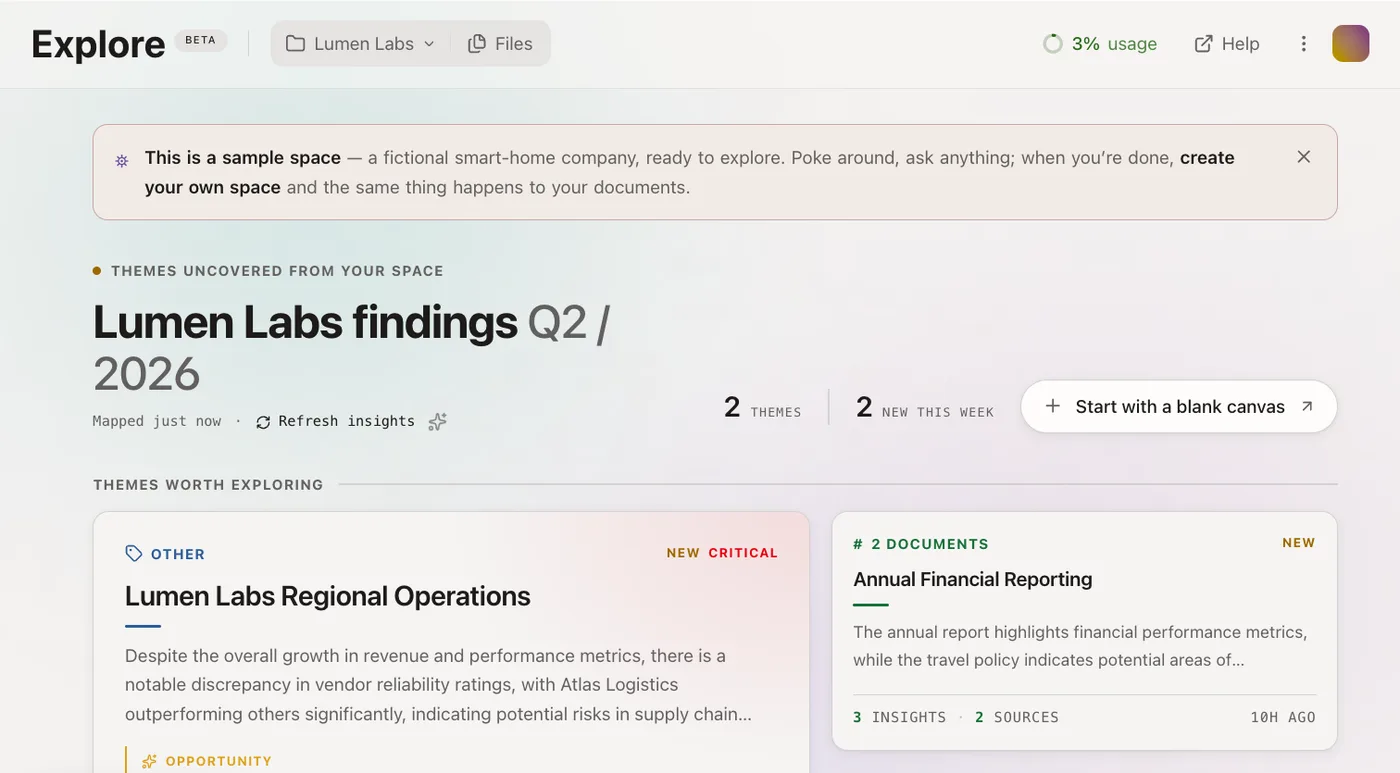
Vendor reliability fell 12% while revenue rose, a supply-chain risk.1,2
What it is
Explore turns a collection of documents (PDFs, reports, transcripts, whatever you’ve got) into answers you can trust and briefings you can share. You ask questions in plain language. It reads across the whole corpus, surfaces the patterns and contradictions, and cites every claim back to its source.
How it works
Three steps:
- Upload a document collection, in any mix of formats.
- Explore it through guided conversation. An AI agent plans, searches and reads to answer, with a quick mode for fast questions and a deep-research mode for the ones that need digging.
- Share the findings as polished, cited briefings and reports.
Built to be trusted
Explore is made for high-stakes knowledge work (due diligence, policy research, litigation support, research and intelligence), where a confident-but-wrong answer is worse than no answer at all. So every claim carries its citation, and it refuses to answer rather than invent when the documents don’t support it.
On mobile
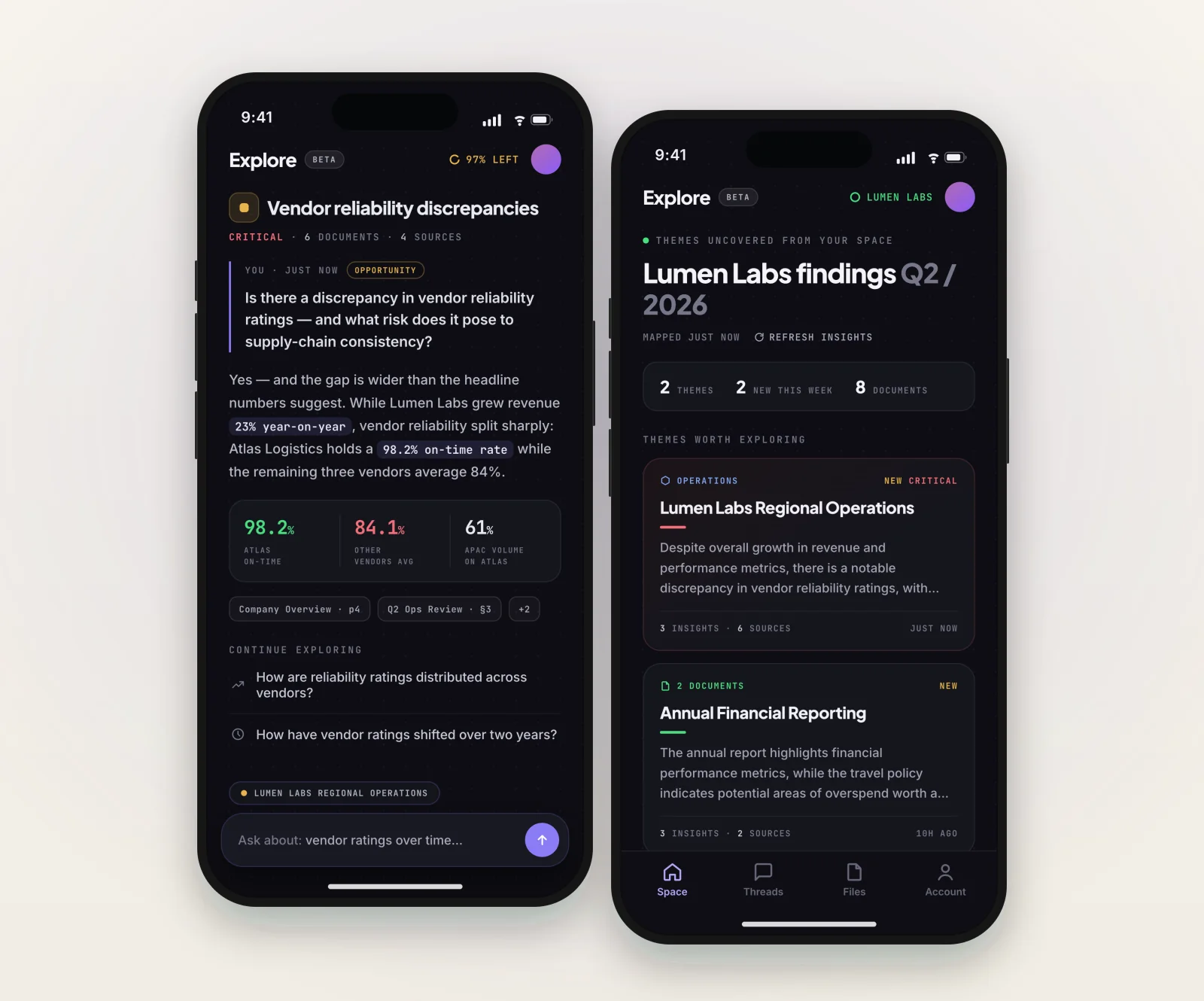
A native app is in design: the same cited answers and mapped themes, in Explore’s dusk palette, made for reading a briefing on the train rather than at a desk.
The platform underneath
Explore is the first product built on The Fabric, Condelo’s AI platform: the ingestion, retrieval, agent and provenance layer that everything Condelo ships runs on. Explore is where those capabilities show up as a real, working product you can put your own documents into.
My role
I’m the product architect, shaping how The Fabric’s capabilities become one coherent product, from ingestion through the conversation to the shareable artefact at the end.
Where it’s at
In private beta. Request access at explore.condelo.app.
Have something in mind?
I’m always happy to talk through an architecture problem, a product to build, or an early-stage idea.